Translucent Kinship lands
Keith Armstrong’s Translucent Kinship is now featured on ANAT’s landing page, continuing a dedicated space for significant moving-image works by ANAT alumni, and expanding the visibility of interdisciplinary creative practice.
A multi-screen immersive video installation, Translucent Kinship draws on LiDAR scans of a regenerating forest at Samford Ecological Research Facility in Queensland. Millions of data points, capturing light across leaves, air, and ground, are rendered as shifting, translucent forms, evoking the complex, reciprocal relationships that shape life within the site. Through these non-human perspectives, the work invites us to consider intelligence not as a singular human trait, but as something distributed across environments, species, and systems of exchange.
The project emerges from Keith’s 2024 ANAT Synapse residency and forms part of the ongoing Forest Art Intelligence (FAI) project, which explores how art can learn from and embed within living systems in recovery. Keith and his collaborators are developing art forms capable of growing and evolving alongside a regenerating forest, whilst also actively benefiting that forest’s health.
Over the past seven years, ANAT’s landing page has foregrounded works that trace relationships between organic life, technology, and transformation. Most recently, Yandell Walton’s Move Me explored a choreographed encounter between human and plant through photogrammetry and motion capture. The two earlier works by Erica Seccombe, Big Pink and Out of Season, revealed the hybrid nature of botanical life through scanning technologies.
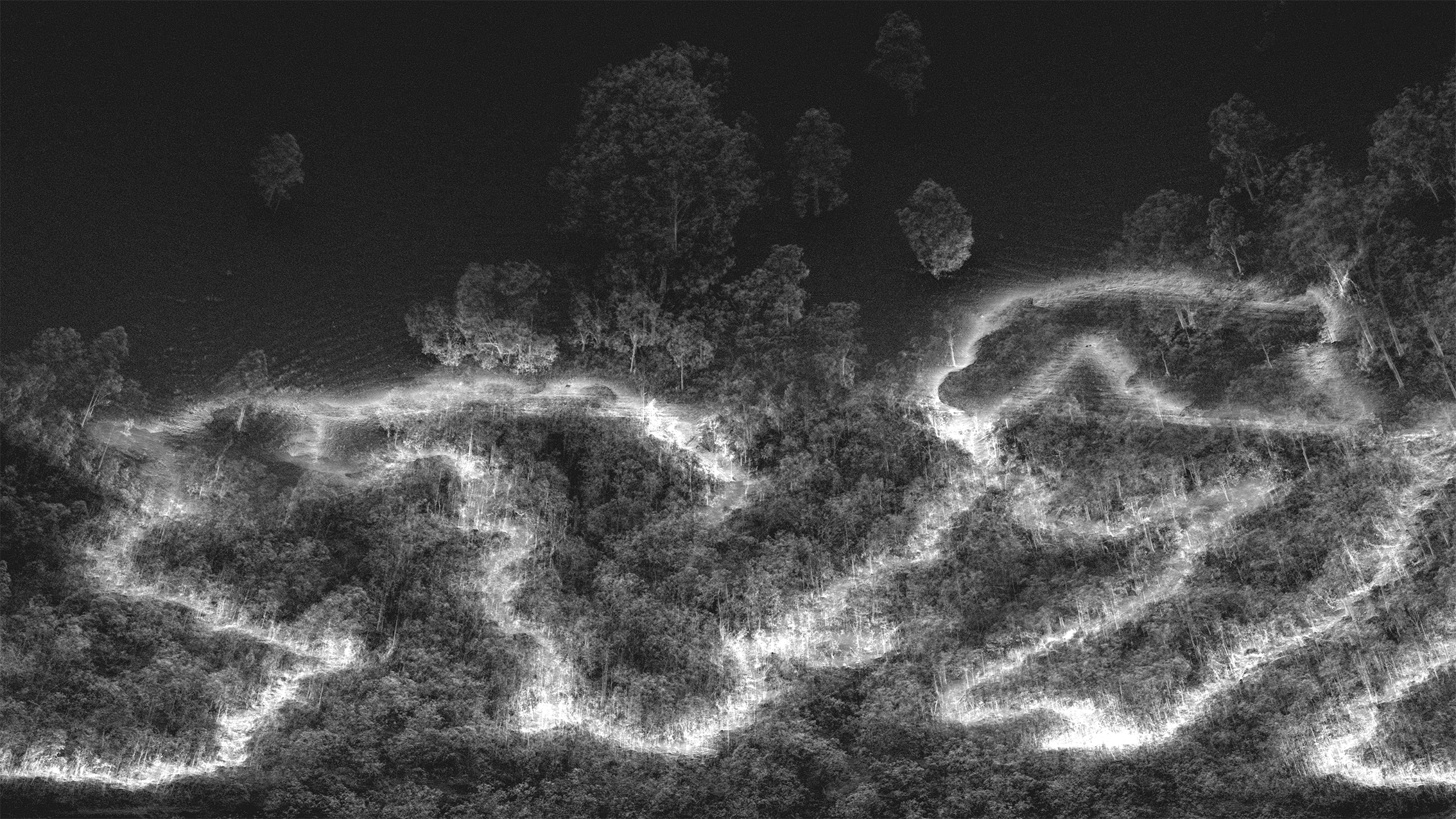
Keith Armstrong, Common Thread (still from uncompressed video), 2022, Held in Collection of ‘.NewArt { foundation;}, Barcelona’, {Shown at ISEA 2022, Barcelona, Novtec 2022, Lima, Peru and V2 Lab for Unstable Media, Rotterdam, 2023}. (Image Keith Armstrong/Visual Data set recorded by Dr. Dmitry Bratanov and Gavin Broadbent, QUT Research Engineering Facility).
In the FAI project Keith says “our art+science team have secured unprecedented permission to restore a currently cleared block of land back to high conservation-value forest at the partner’s site, Samford Ecological Research facility (SERF). As the forest ecology is slowly returning to health, we are investigating how to develop symbiotic, process-based artworks across that entire site. We imagine ‘Art Intelligences’ are capable of growing & evolving with the forest whilst occupying their own intelligent, ecological ‘niches’ within that emerging forest – with the forest itself being the project’s ‘meta-artwork’. ”
“Concepts of “thing” and “environment” are inextricably connected. They belong together; they presuppose each other. Nothing exists in isolation. Nothing exists without a larger world to which it belongs”
Holdrege, C & McAlice, J,
Keith Armstrong is an experimental artist whose practice spans three decades of collaborative, site-specific and art–science work driven by social and ecological justice. His projects invite audiences to imagine collective pathways toward more sustainable futures.
Working across performance, installation and interactive systems, Armstrong explores how scientific and philosophical ecologies can shape new artistic forms—positioning artists as agents of change. He has created over sixty major works presented widely in Australia and internationally.
Recent projects include Uramat Mugas (APT10, GOMA), Common Thread (ISEA 2022), and the touring work Carbon_Dating (2023–25). In 2024, he began the long-term Forest Art Intelligence project through his second ANAT Synapse residency, from which Translucent Kinship (2025) emerges.
Collaborating Science Team: Dr David Tucker (QUT Landscape Ecologist), Dr Gabrielle Lebbink (QUT Freelance Plant and Invasion Ecologist), Dr Eleanor Velasquez (TERN Education and Training Manager at Terrestrial Ecosystem Research Network TERN Australia) and Marcus Yates (QUT/SERF Site Technician). Further supported by A/Prof Caroline Hauxwell (QUT Microbiologist and Agricultural Biotechnologist).
PARTNERS: The Australian Network of Art and Technology (ANAT) in partnership with the University of the Sunshine Coast (UniSC), hosted ANAT SPECTRA 2025 :: Reciprocity on Kabi Kabi/Gubbi Gubbi Country, in the heart of the Sunshine Coast Biosphere Reserve. Special thanks Melissa DeLaney (ANAT) and team, Toby Gifford and Leah Barclay (UniSC).
Further supported by The Australian Government through Creative Australia, its arts funding and advisory body, SERF (Samford Environmental Research Facility) and the NCRIS-enabled Terrestrial Ecosystem Research Network (TERN), Lorrelle Allen + Site Technician Marcus Yates, QUT School of Creative Arts, QUT More Than Human Futures Group and the Centre for the Environment and Society. Collaborating Science Team: Dr David Tucker, Dr Gabrielle Lebbink, Dr Eleanor Velasquez (TERN) and Marcus Yates. Visual data set collected and processed to registered point cloud by Dr. Dmitry Bratanov and Gavin Broadbent, Research Engineering Facility, Office of Research Infrastructure, QUT, Brisbane, Australia.