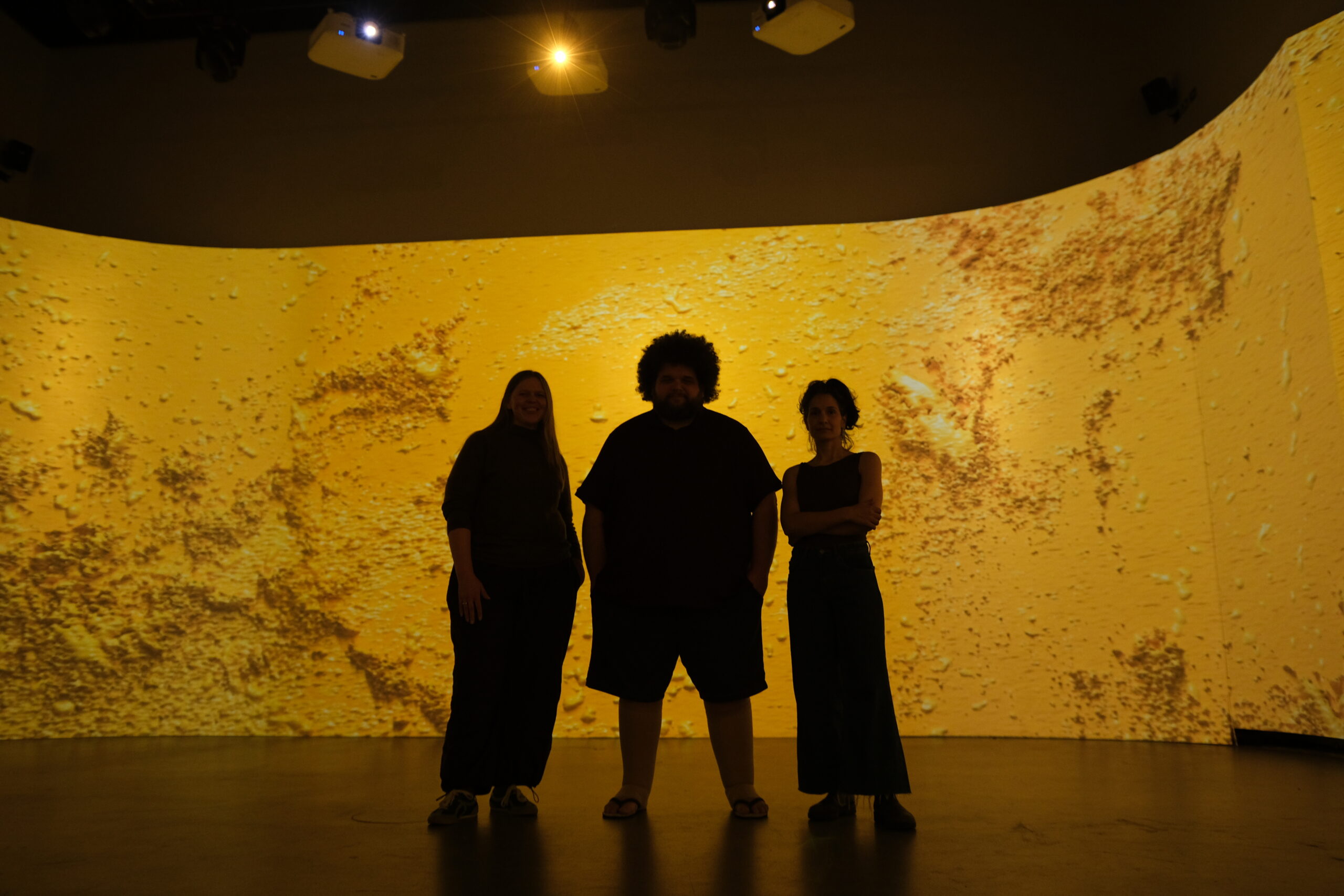
From left Georgia Hayward, Peter Swanton and Prita Tina Yeganeh, in front of their work Darkness in 589, The Cube, MAP mima. Photograph Nisa East.
2026 ANAT + MAP mima Residency & Commission
GEORGIA HAYWARD
PRITA TINA YEGANEH
PETER SWANTON
ANAT and Multi-Arts Pavilion, mima (MAP mima) are delighted to announce Darkness in 589, a collaborative research project by Peter Swanton, Prita Tina Yeganeh, and Georgia Hayward.
Darkness in 589
2026
video and stereo sound
8:04 minutes
Peter Swanton, Georgia Hayward and Prita Tina Yeganeh
“…everything on the land is reflected in the sky, and everything in the sky is reflected on the land.”¹
— Elders and Knowledge Holders Ghillar Michael Anderson, John Barsa, David Bosun, Ron Day, Segar Passi and Alo Tapim, The First Astronomers.
Darkness in 589 is a 360-degree projection artwork that reframes darkness; not as an absence, but a vital ecological, cultural and sensory condition. Born from an interdisciplinary collaboration between Gamilaraay/Yuwaalaraay astrophysicist Peter Swanton, whose research focuses on cultural astronomy and dark sky preservation, Iranian artist and printmaker Prita Tina Yeganeh, and Mardigan/Anglo-Celtic artist Georgia Hayward, Darkness in 589 invites audiences to consider through their senses what darkness sustains and what is at risk of being lost due to light pollution.
During a residency at Siding Spring Observatory in Warrumbungle Dark Sky Park—a meeting place of the Wayilwan, Gamilaraay and Wiradjuri peoples—the collaborators immersed themselves in natural darkness. Through an experimental research process, they gathered circadian biometric data alongside records of their emotional responses, documenting the night as both a bodily and a felt experience.
Pattern, symbolism and sound translate these experiences, mapping a continuous twelve-hour nocturnal period into an eight-minute moving-image work. Field recordings from the park are woven into a score structured around the collaborators’ sleep–wake cycles circadian data. As each new data-point appears, a corresponding sound and symbol marks its passage, giving visual form to the bodily and ecological rhythms recorded through the night.
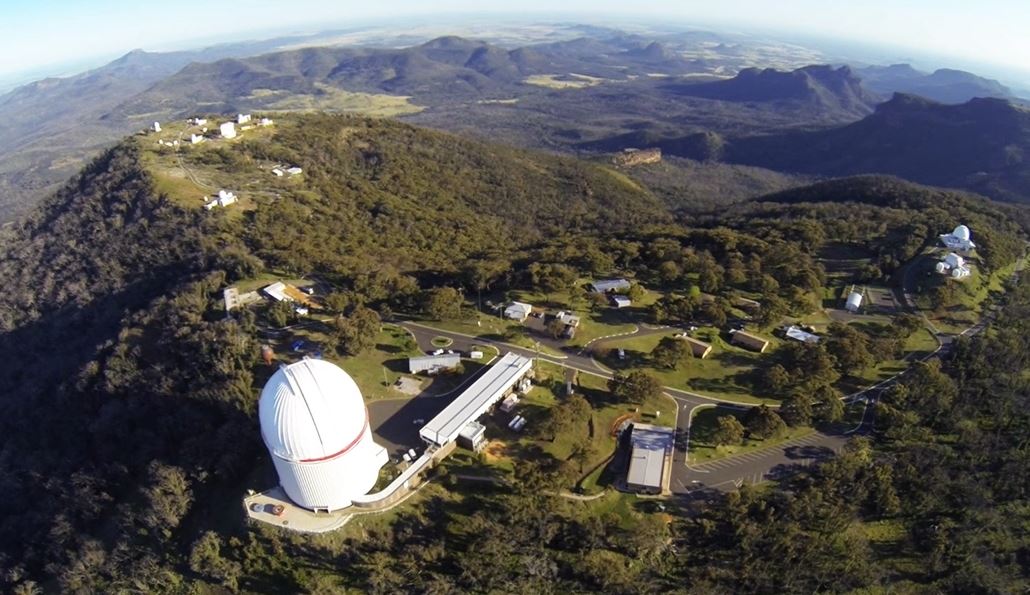
Siding Spring Observatory, New South Wales. Photo: Ssopete / Wikimedia Commons (CC BY-SA 4.0).
Guided by cultural knowledge shared by Swanton, the work is shaped by his understanding of interconnectedness—that everything in the sky is mirrored in the land. Underpinning the work is the sound of Yarran—a Gamilaraay creation story—heard in the wind passing through Red Gum leaves and layered with Swanton’s voice, illuminating the necessity of darkness to sustain cultural stories and oral traditions held in the night sky.
Patterns slowly emerge within the projection, echoing how the night revealed its textures and forms as the collaborators’ eyes adjusted to darkness. The imagery draws on frottage—an artistic technique of making rubbings from textured surfaces—transformed through digital printmaking. Textures gathered from the land become an emerging visual language that collapses the distance between the cosmic and the terrestrial, bringing them into relation and emphasising the importance of darkness across Country and the interconnectedness of people, land and sky.
The work responds to the loss of natural darkness through the global threat of light pollution, which now compromises the environmental, cultural and physical health of more than eighty percent of the world’s population. Anchored by a 589-nanometer wavelength, the work’s rich amber serves as the foundational colourway. The colour references 589-nanometre amber light, a wavelength used as a compromise where artificial illumination is necessary, minimising the impacts of artificial light on plant, animal and human life while remaining a source of light pollution. This colour becomes a point of tension within the work—an experience made through light that asks us to attend to darkness.
Darkness in 589 invites audiences to feel what darkness reveals and what we stand to lose when our bodies, environments, stories and skies no longer share the dark.
Exhibition details
Exhibition: Friday 25 September – Sunday 29 November 2026
Opening Event: 5–7pm, Friday 25 September 2026

Peter Swanton, Georgia Hayward and Prita Tina Yeganeh.
About the team:
Peter Swanton is a Gamilaraay astrophysicist, Indigenous Research Associate with Australia National University (ANU) and an Executive Director of the Australasian Dark Sky Alliance.
Georgia Hayward is a Mardigan and Anglo-Celtic artist, curator and writer whose practice examines colonial power across social, spatial and digital forms, fostering more place-responsive ways of relating.
Prita Tina Yeganeh is a multidisciplinary artist and facilitator whose practice spans community engagement, installation and moving image, drawing on her Iranian heritage and environmental engineering background to explore land politics, migration, identity and health.
About the collaboration
The ANAT + MAP mima Artist Residency and Commission supports artists and researchers to experiment at the intersection of creative practice, scientific inquiry and emerging technology. Through this partnership, artists receive time, space, and technical support to develop ambitious new work for MAP mima’s unique immersive environment.
ŊARI / GAMBIRA
In July 2026, Blue Art Journal commissioned Georgia Hayward to write for its second volume, We Move Through Time, Time Moves Through Us. Georgia’s essay, ŊARI / GAMBIRA, explores how light pollution is erasing darkness as a vital ecological, cultural and scientific condition, severing ancient relationships with sky Country.
The piece also touches on the early stages of Georgia, Prita and Peter’s 2026 ANAT + MAP mima Residency & Commission, The Darkness. Their goal was to render these invisible impacts visible. “Positing darkness not as absence,” says Georgia, “but as a vital ecological condition.”
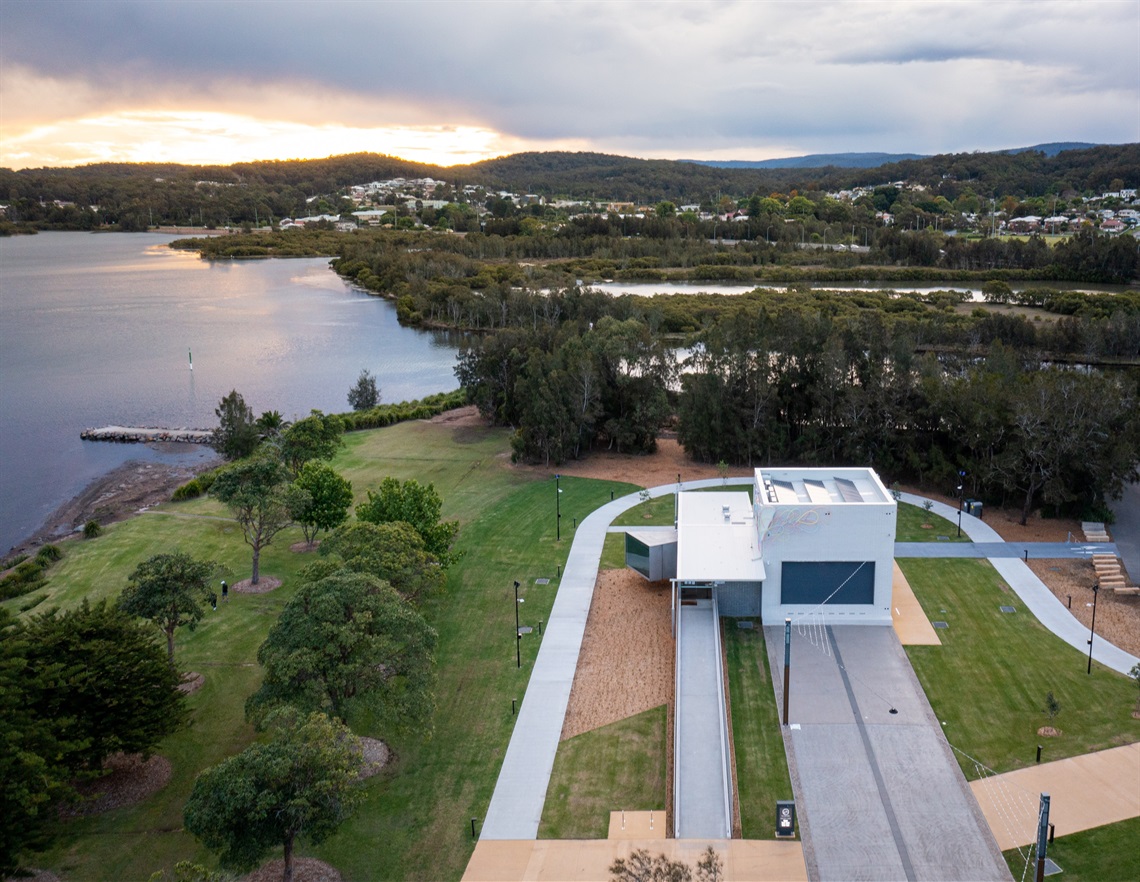
Lake Macquire Museum of Art and Culture, Multi-Arts Pavillion, mima.
ANAT and Lake Macquarie City Council (LMCC) are co-sponsoring the commission.
The Multi-Arts Pavilion, mima (MAP mima) is a versatile space for digital art and performance in Speers Point Park. This cutting-edge venue brings together art and innovation with an exciting program of exhibitions, concerts, performances and events throughout the year.
The building is embedded and surrounded by public artworks including a play sculpture by artist Sanné Mestrom, an interactive soundscape, an augmented reality landscape and light installations. Inside is an immersive 360-degree projection space wtih artists creating new video works through a residency program and annual commission.
Previous residencies:
Wanjun Carpenter: Cathode Dream
Jen Valender: Broken Chord
Joel Zika: Valley of a Thousand Plants
Lina Buck: It isn’t Always, Always
Miguel Felipe Valenzuela and Julia Flanagan: Endless Sunbeams in Another Time
Lichen & Luna: Passing Clouds