Q&A August
In 2026, our monthly Q&A series turns its focus to the artists, peers and cultural leaders working alongside us to champion artists and the possibilities of interdisciplinary practice.
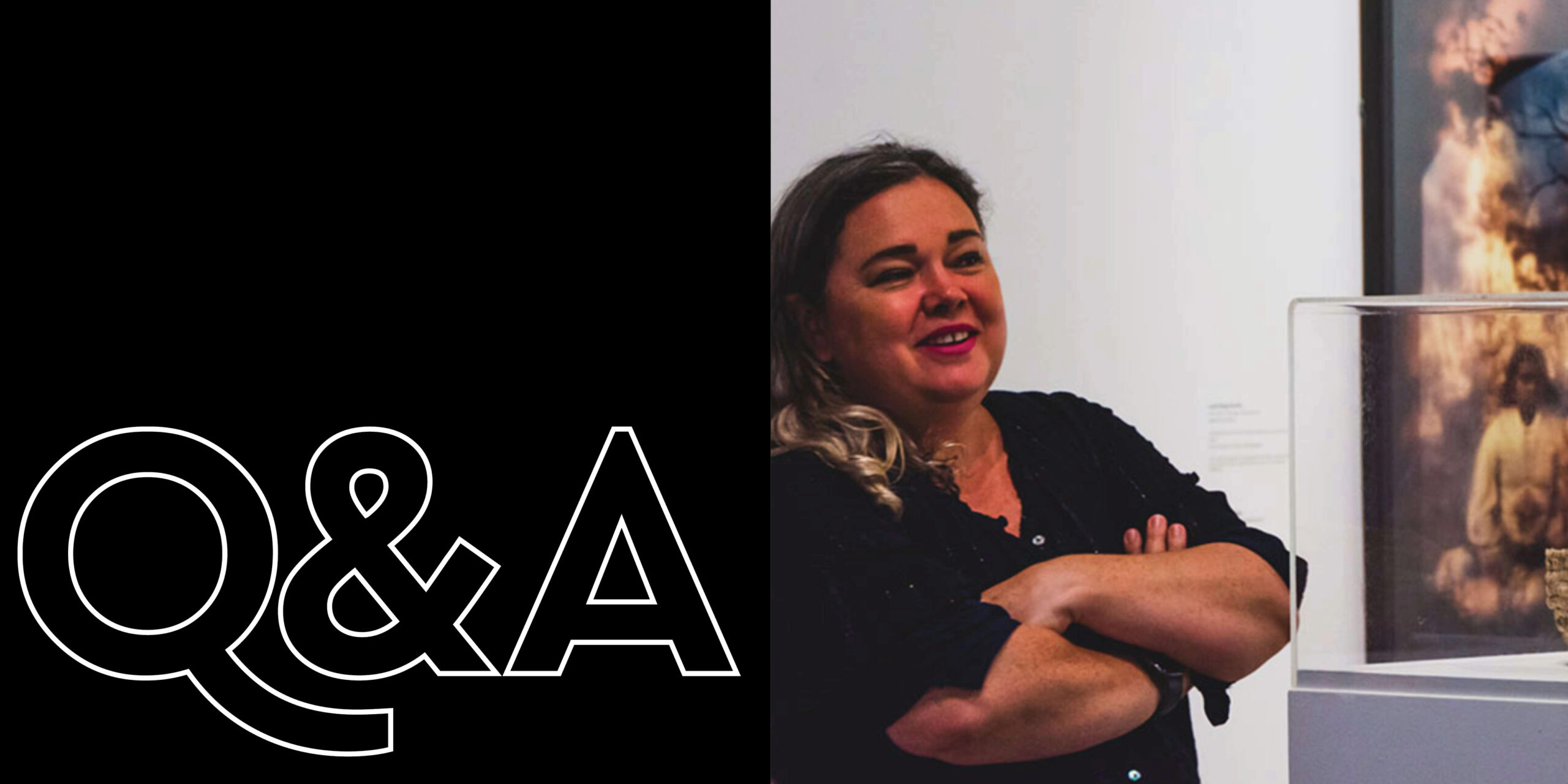
Ali Gumillya Baker, image courtesy Vitalstatstix.
Ali Gumillya Baker
I am a Mirning person living on Kaurna Yarta, and have been raised amongst the Nunga community in Adelaide. My creative work and research praxis is interdisciplinary at its core, because our knowledges span across all of the disciplinary knowledges that arrived with colonialism. Our knowledges have also been (and in some cases continue to be) excluded from disciplinary teaching in many sites of research and learning across our countries in what is now called Australia.
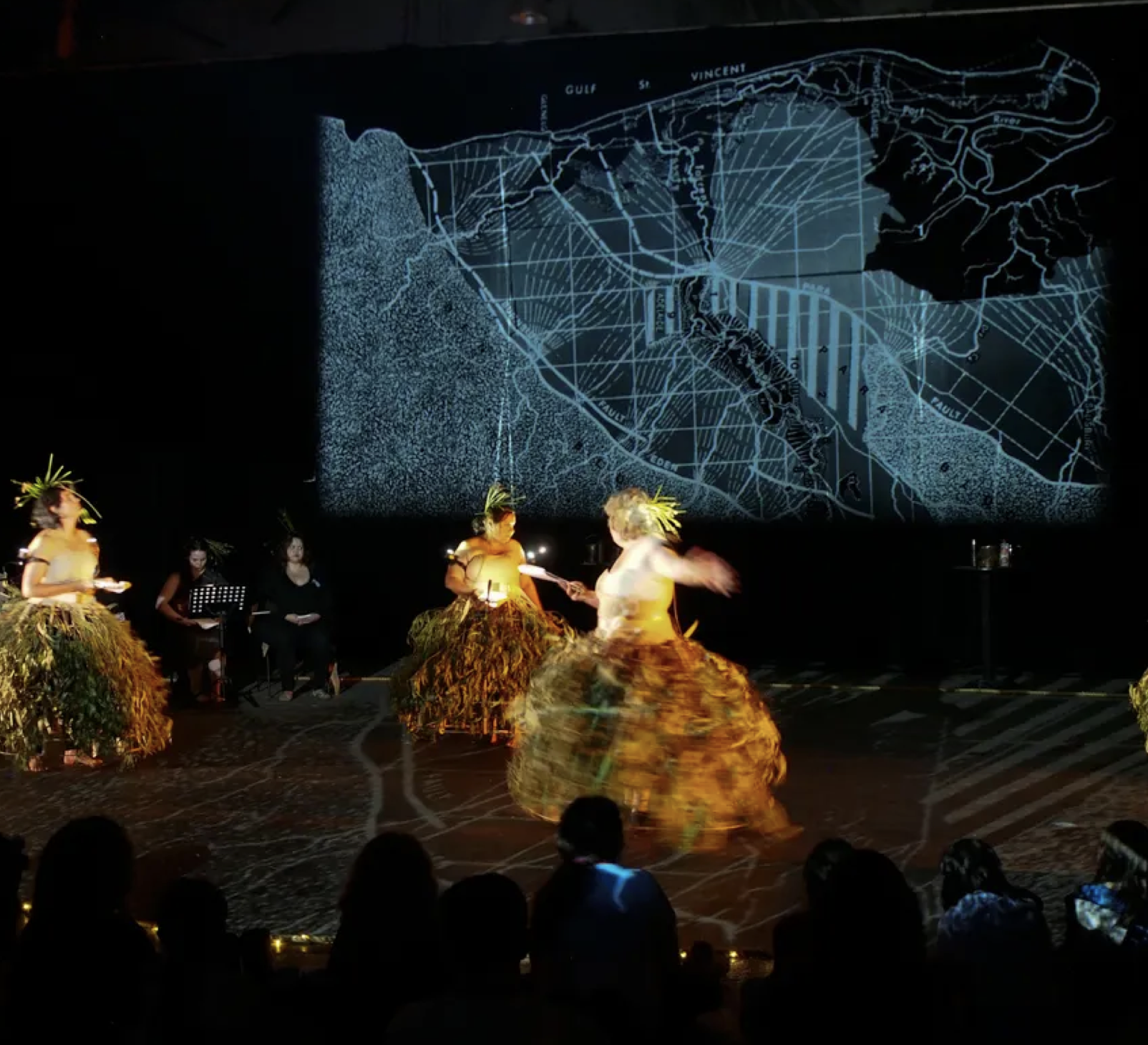
Unbound Collective, 2018, Sovereign Acts III REFUSE, commissioned by Vitalstatistix, for Climate Century, performed at Harts Mill, Yarta Puulti, with collaborators Katlin Inawanji Morrison, Dr. Lou Bennett & Bonny Brodie, image Tony Kearney.
How has collaboration across disciplines shaped your work and/or practice?
The Unbound Collective (of which I am a member) have all had different disciplinary training and it was bringing together our various skills of installation, performance, photography, filmmaking, poetry, singing and shared theoretical- ethical standing, as well as deep ancestral connections to Indigenous country- place and commitments to justice in the present that informs our collaborative art practices.
“By the time I had completed watching this story it had shifted my consciousness in ways I can’t fully describe, except that I had a deep physical compassion, respect and love for this old story and its connection to Inuit country, for the beauty, humor and old methods of storytelling.”
Which film, book, exhibition or moment shifted the way you see the world?
There are so many films and books and artworks that have shifted my thinking deeply.
When I was in my late teens I decided to spend many years only focussed on reading black and brown women authors, this was a conscious rebalancing of my primary and secondary education which had been (un)shockingly biassed toward the texts of white men. During this time before the internet I read many books that were epic in the ways they opened me up, ones that stand out as life changing at various times were; The Temple of My Familiar by Alice Walker, The Bone People by Keri Hulme and Beloved by Toni Morrison, recently the work of Leanne Betasamosake Simpson and Alexis Pauline Gumbs have been vital.
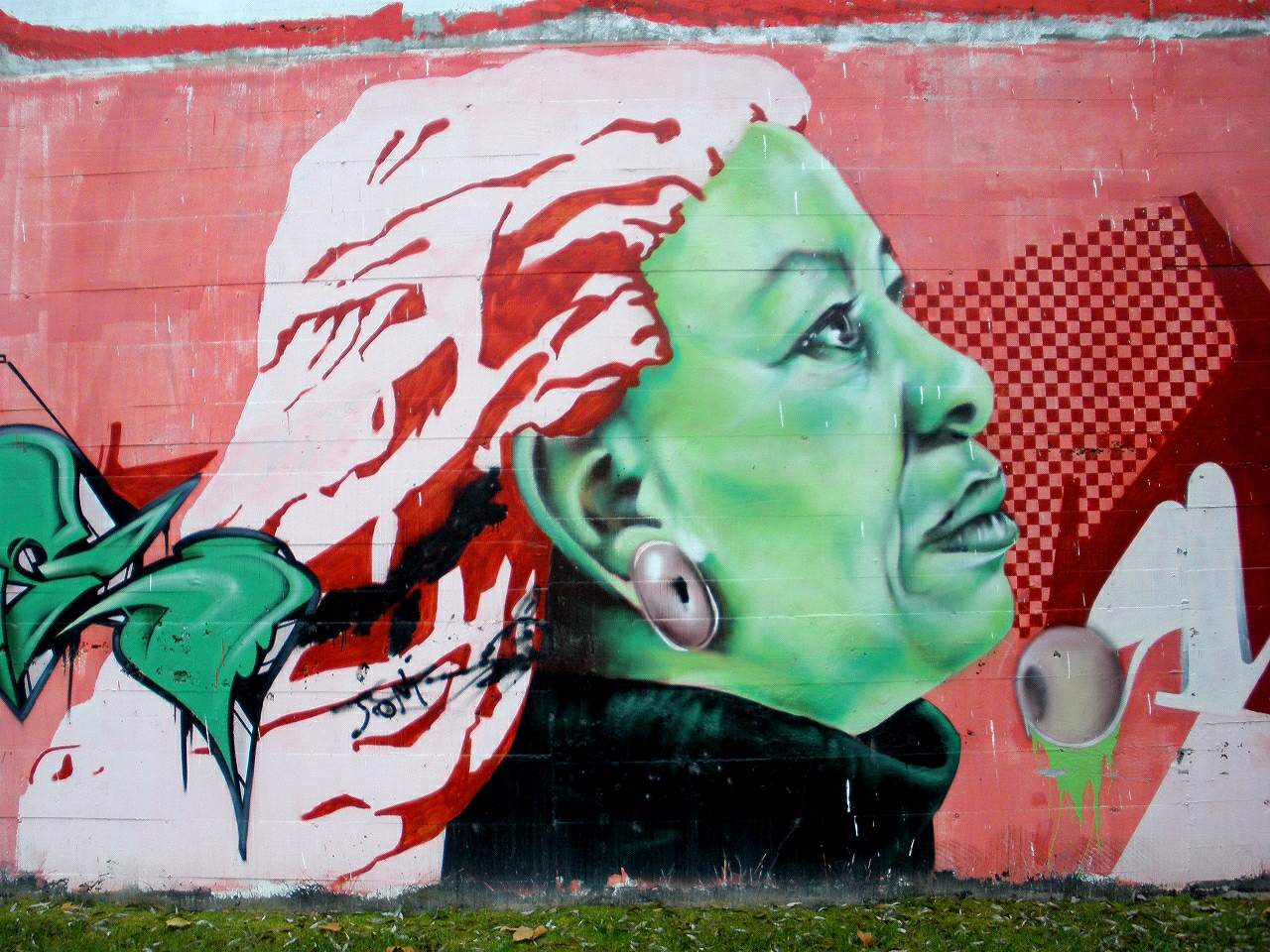
Mural depicting Toni Morrison by Jorge Rodríguez-Gerada. Photo by Zarateman, via Wikimedia Commons (CC0 1.0).
I have watched Tracey Moffatt’s Night Cries a Rural Tragedy with my students so many times I could not count. I think every time I sit with this work something new about its form or composition or a specific feeling or memory strikes me. The work is a stunning woven layering of specific symbols that connect white Australia to so many Aboriginal tropes in the representational history of this country, it continues to resonate so clearly.
Vernon Ah Kee’s moving image work tall man is one of the most powerful moving image works I have ever seen for its mixture of sound and found-donated footage of the Palm Island riots, and delivers a breathtakingly powerful culmination that cuts deep into police racism, deaths in custody, and violence towards Aboriginal people in Queensland.
I watched the work of Lelya Stevens GROH GOH (Rehearsal for Rangda) 2023 which was part of the Tarra Warra Biennial of the same year. Stevens work expanded my understanding of life, the powerful understanding of walking the edge between life and death, a feeling also required to fully surrender to death in order to give birth, the centre of the molten earth a life-death-life force.
Another film that had a similar impact was Atanarjuat: The Fast Runner (Inuktitut: ᐊᑕᓈᕐᔪᐊᑦ) is a 2001 Canadian film directed by Inuk filmmaker Zacharias Kunuk. It was the first feature film ever to be written, directed and acted entirely in the Inuktitut language. This is a really long feature film that runs for nearly 3 hours and during this time it teaches the viewer different understandings about time and pace in storytelling and how culturally specific these narrative structures are. By the time I had completed watching this story it had shifted my consciousness in ways I can’t fully describe, except that I had a deep physical compassion, respect and love for this old story and its connection to Inuit country, for the beauty, humor and old methods of storytelling.
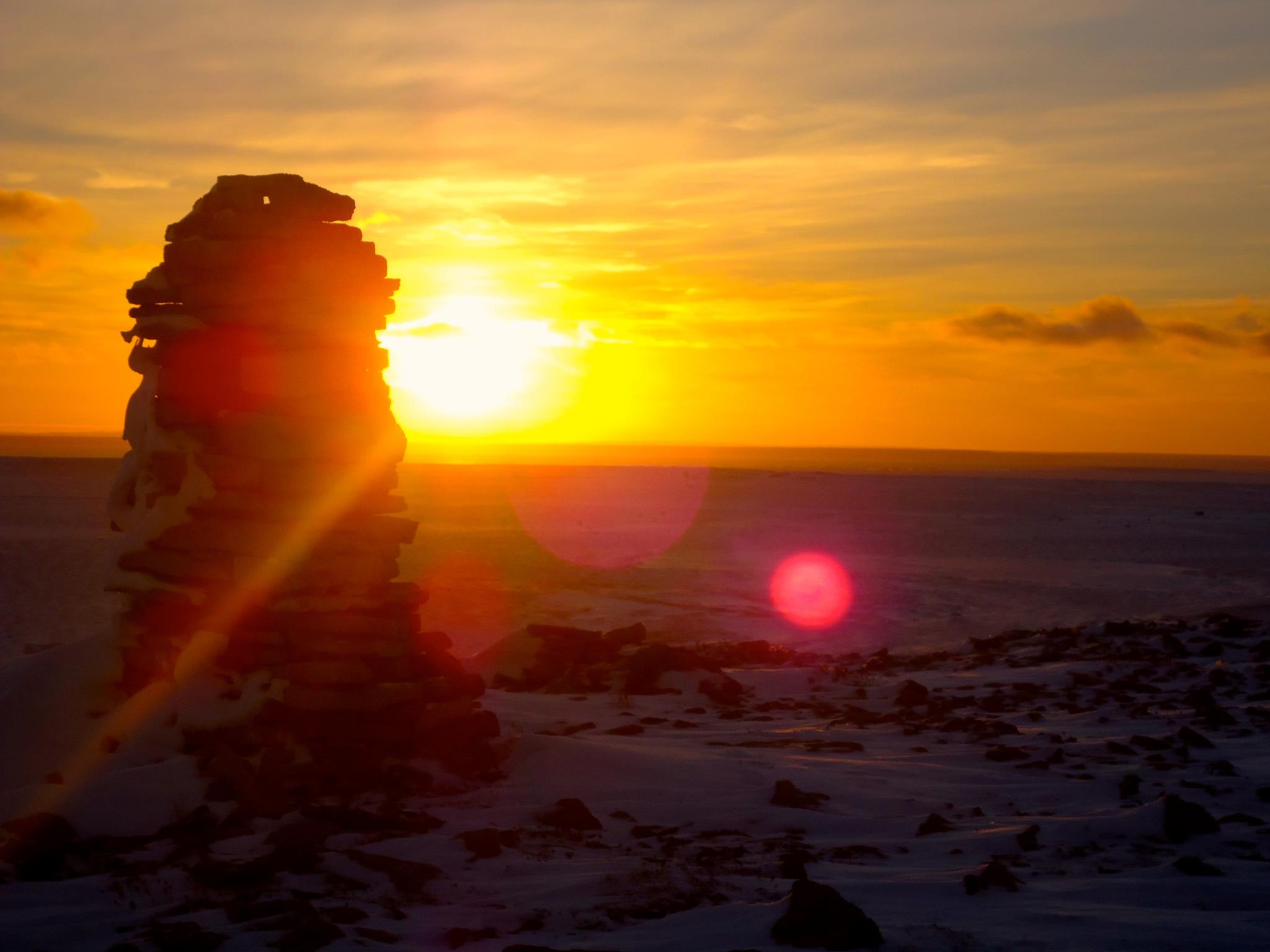
Inuksuk at Igloolik, Nunavut, Canada. Photo by Nunaview, via Wikimedia Commons (CC BY-SA 3.0)
Who would be your dream collaborator and what would you want to create together?
Unbound Collective have has many dream collaborations, we have worked with Julie Gough, Romaine Moreton, Lou Bennett, Katerina Teaiwa, Leanne Betasamosake Simpson, we have collaborated with incredible Kaurna elders and artists, as well as artists and elders from all over the country.
I would love to collaborate with the incredible Blak Laundry and their travelling yarn tent, I also deeply admire the work of Paola Balla and also I am interested in the work of Joar Nango and his ongoing project Girjegumpi : Sami Architecture library, and more broadly nomadic architecture of change. Nango’s collaboration featured in the 2023 Venice Architecture Bienalle in the Nordic Pavillion, when I was there as one of the creative directors on a project unsettling Queenstown in the Australia Pavilion.
I would also love to collaborate more with my Mirning family and my children.
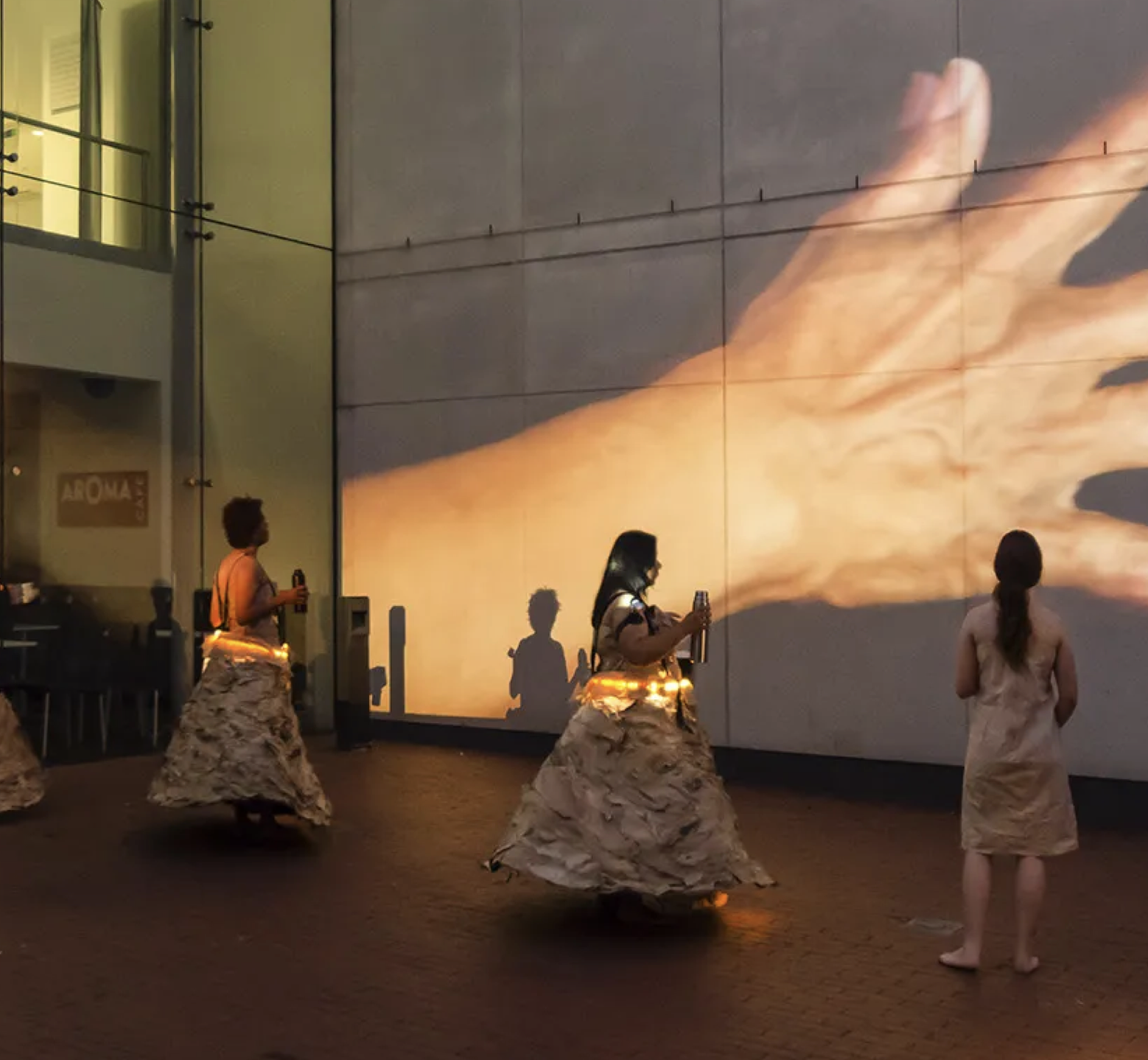
Unbound Collective, 2015, Sovereign Acts, Act I, commissioned by TARNANTHI and FUMA, performed between The State Library of South Australia and The South Australian Museum, with additional funding from the Australia Council. Image Steve Rendoulis.
What’s next on your horizon, a project, an idea, a wild experiment?
I am currently working on a series of unfolding works about my great-grandmother country and the sky. The series falls under a title of the last place we looked for her, and covers what I am describing as sky-camp archives.
“the pressures of imagining that we are alone in competitive cannibalising colonial systems of power”
ANAT supports work that pushes boundaries and connects fields. How do you see your work contributing to new ways of thinking or creating in the world?
I usually work collaboratively and this collaborative work has been most beneficial to pushing boundaries and letting go of individualism and the pressures of imagining that we are alone in competitive cannibalising colonial systems of power. When I think about what is most important and about significant boundaries that we would like to transgress it is the intersection of change and what has been silenced. There are many knowledges humans have learned and forgotten there are many things that are superficial and unnecessary. Resonant truths are like some sounds -something that speaks with clarity over time. Something that travels deeply that we collectively understand that inspires justice and change that is a promise of life.
What do you think of when you think about ANAT?
I think about the spectrum of technology, patterns and systems and knowledge collaboration.