Q&A May
In 2026, our monthly Q&A series turns its focus to the artists, peers and cultural leaders working alongside us to champion artists and the possibilities of interdisciplinary practice.
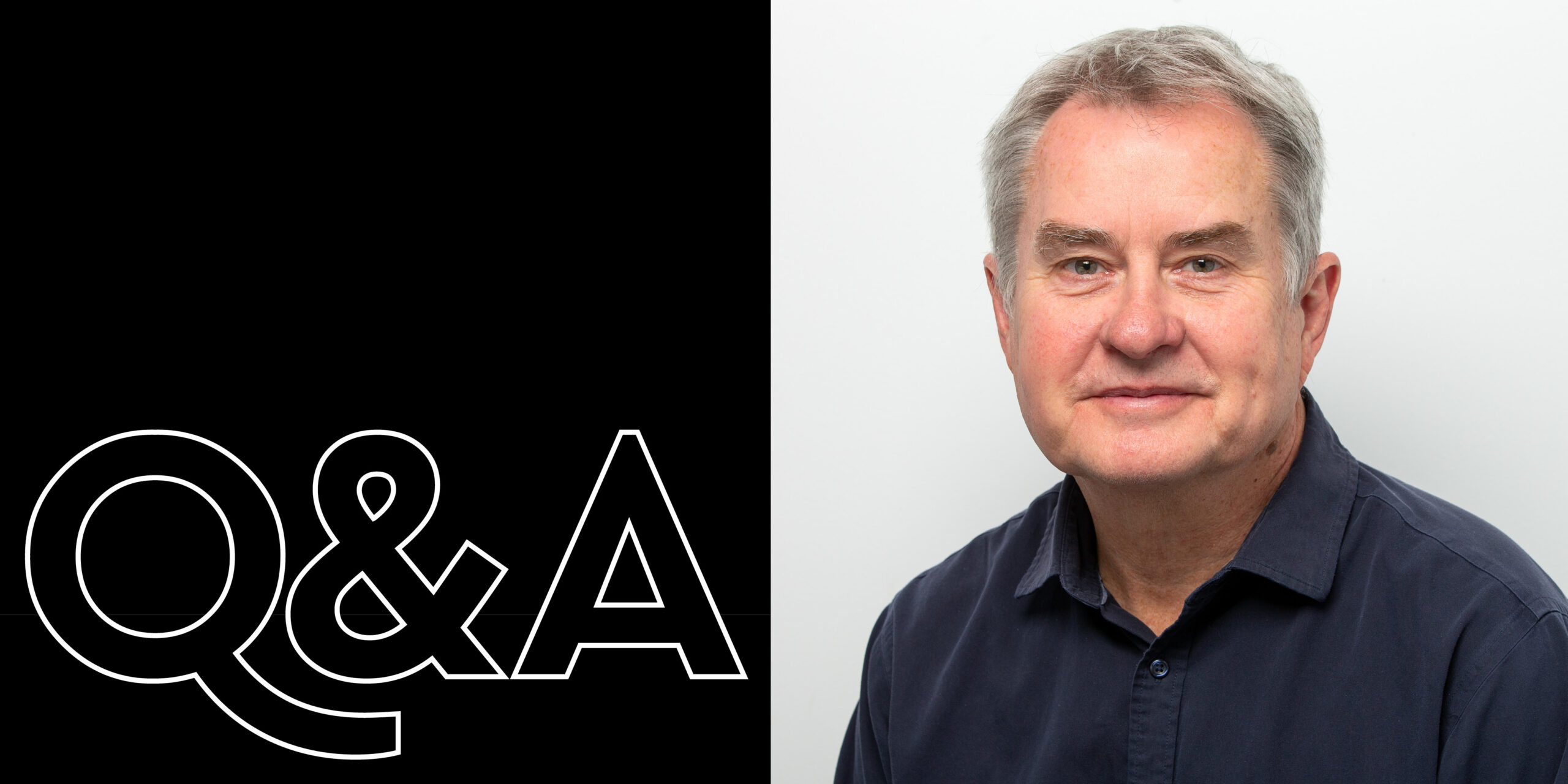
Ed James, photograph John Nieddu.
Ed James
Ed James is a photo media artist and public art and gallery coordinator, based in Kaurna Yarta (Adelaide), South Australia.
Ed worked as a storeman and photographic film processor before studying art and entering the South Australian arts industry in 2003. He has supported emerging artists and had a small stint in tertiary education before taking a predominately public art role in local government.
From his early experiences in the creative industries Ed understands the importance of supporting artists and that a little financial or other form of support goes a long way. He also has a strong interest in science, its big unsolved questions, and a belief in pure scientific enquiry without agendas or binding outcomes.
Supporting artists remains a focus of Ed’s interests along with engaging local communities and creatives in the facilitation of art exhibitions and new public artworks.

Ed James, Secret Name.
How has collaboration across disciplines shaped your work and/or practice?
From a background working in commercial photographic film labs, I entered art school as a mature student in 1999 specifically to study Photoshop and unexpectedly ended up with a career in the arts both as artist and arts worker. In 1999 I was fortunate to be accepted into the North Adelaide School of Art (NASA) that later merged with the Centre for Performing Arts (CPA) and became the Adelaide College of the Arts (AC Arts) located in Light Square, Adelaide, where I graduated with a degree in Visual Art & Design. The merging of Performing and Visual Arts was a bonus because I was then exposed to new art disciplines incorporated within the same building including dance, acting, and stage and costume design, opening new opportunities to work with other creatives.
Which film, book, exhibition or moment shifted the way you see the world?
In 1971, the Art Gallery of South Australia staged the pioneering exhibition Air, which was the first major survey of environmental and conceptual art in Australia. My parents took me to this exhibition as a child and it became a seminal moment in my life, exposing me to experimental, interactive and cutting-edge technological based art, while also endearing me to the South Australian Art Gallery itself.
Key Details of the “Air” Exhibition
Significance: It is widely regarded as one of the most influential exhibitions in Australian art history, representing a shift toward Conceptualism and Post-Object art.
Curation: The exhibition was curated by Donald Brook, a former critic for The Sydney Morning Herald and a key figure in the “experimental” art scene who had recently moved to Adelaide where he became a founding member of the Experimental Art Foundation (EAF)
Participating Artists: It featured works by leading contemporary artists such as Tim Burns, Aleksander Danko, and Bert Flugelman.
The “Air” Theme: The exhibition famously featured “dematerialised” works, including inflatable sculptures and ephemeral installations that challenged the traditional idea of art as a permanent, physical object.
Legacy: “The exhibition’s focus on air and temporary installations was considered radical at the time, sparking intense debate in the Adelaide art community and solidifying the gallery’s reputation for supporting avant-garde movements.” Artlink Australia 1971

Sean Carroll .Image Creative Commons.
Who would be your dream collaborator and what would you want to create together?
My three favourite scientists & podcasters are Sabine Hossenfelder, Professor Paul Davies & Sean Carroll. Either or all of these people would be an honour to work with creatively. I don’t have anything particular in mind for an art science project however my approach would be to initiate a number of casual meetings with the notion that a creative project from both parties would soon evolve. All three scientists have an interest in the cosmos and the big questions of Dark Matter, the Theory of Everything and the possibility of Alien life, all questions I am personally interested in.
What’s next on your horizon, a project, an idea, a wild experiment?
At the time of writing this I don’t have a project on the horizon. For me ideas need time and space to seep into my thought processes. I am always hopeful that my next project will eventually manifest itself. My most recent exhibition SLOW showed a series of digital photographs utilising Hi-Viz safety clothing and signage that imagined cautionary paraphernalia as prompts to remind us to slow down both in our physical and psychological states. The idea for these recent art works seemed to come from somewhere in the universe, however I think maybe the current state of the world may have influenced my conceptual thinking.

Ed James, SLOW #2.
ANAT supports work that pushes boundaries and connects fields. How do you see your work contributing to new ways of thinking or creating in the world?
With my art I personally aim to push the technology I am using to discover new imagery from within the original photograph. I try hard to create anti-photos as a direct result of my early life working in a commercial film processing laboratory. In my film lab work I worked with commercial photographers who perfectly exposed, framed and focused their images that were then perfectly processed in the laboratory. While at the photo lab I began experimenting with different cross processing techniques for my own photography that eventually led to a portfolio of works that enabled me to enter art school. By using traditional and non-traditional equipment for capturing images I then push the digital files to their limits as a way of discovering hidden imagery located within the digital files. I am most happy working this way and find it to be an exciting journey of discovery.
What do you think of when you think about ANAT?
In 2004 while studying arts management at the University of South Australia. ANAT generously supported me with a small grant that enabled me to undertake a one-month placement with the International Symposium of Electronic Art (ISEA) in Helsinki, Finland. This opportunity opened so many networking and career opportunities for me for which I am forever grateful.
Again in 2004 a second ANAT opportunity occurred when I was accepted as a representative of my artist collective SHOOT to participate in a masterclass program Luminosity, a public art moving image projection initiative for SA-based new media artists that investigated themes of sustainability around the city of Adelaide. ANAT worked closely with Adelaide City Council and the Capital City Committee to develop Luminosity, in collaboration with Brisbane-based projection artist Craig Walsh together with Stephen Thomassen from God Lab.
The Masterclass focussed on a high degree of experimentation and as an outcome of my masterclass the SHOOT artists collective developed and screened the large-scale moving image projection Metrospective on the Target wall in Rundle Street East, Adelaide. Metrospective addressed the visual landscape we occupy through a constantly changing collage of consumerist images that are peeled away to create new combinations of visual language.
When thinking of ANAT I see:
- a culturally significant international arts organisation with a base in Adelaide,
- an art and science facilitator at the intersection of new creative ideas and technologies,
- an enabler, providing collaborative opportunities for the arts and sciences,
- a facilitator of first nations stories,
- a compassionate, caring and thoughtful organisation, and
- a safe space to explore ideas and experimentation.