Q&A December
This year, in celebration of our triennial event, ANAT SPECTRA :: Reciprocity, our monthly Digest Q&A series is spotlighting alumni from past ANAT SPECTRA events. Each month, we’ll feature the interdisciplinary trailblazers integral to our triennial gatherings.
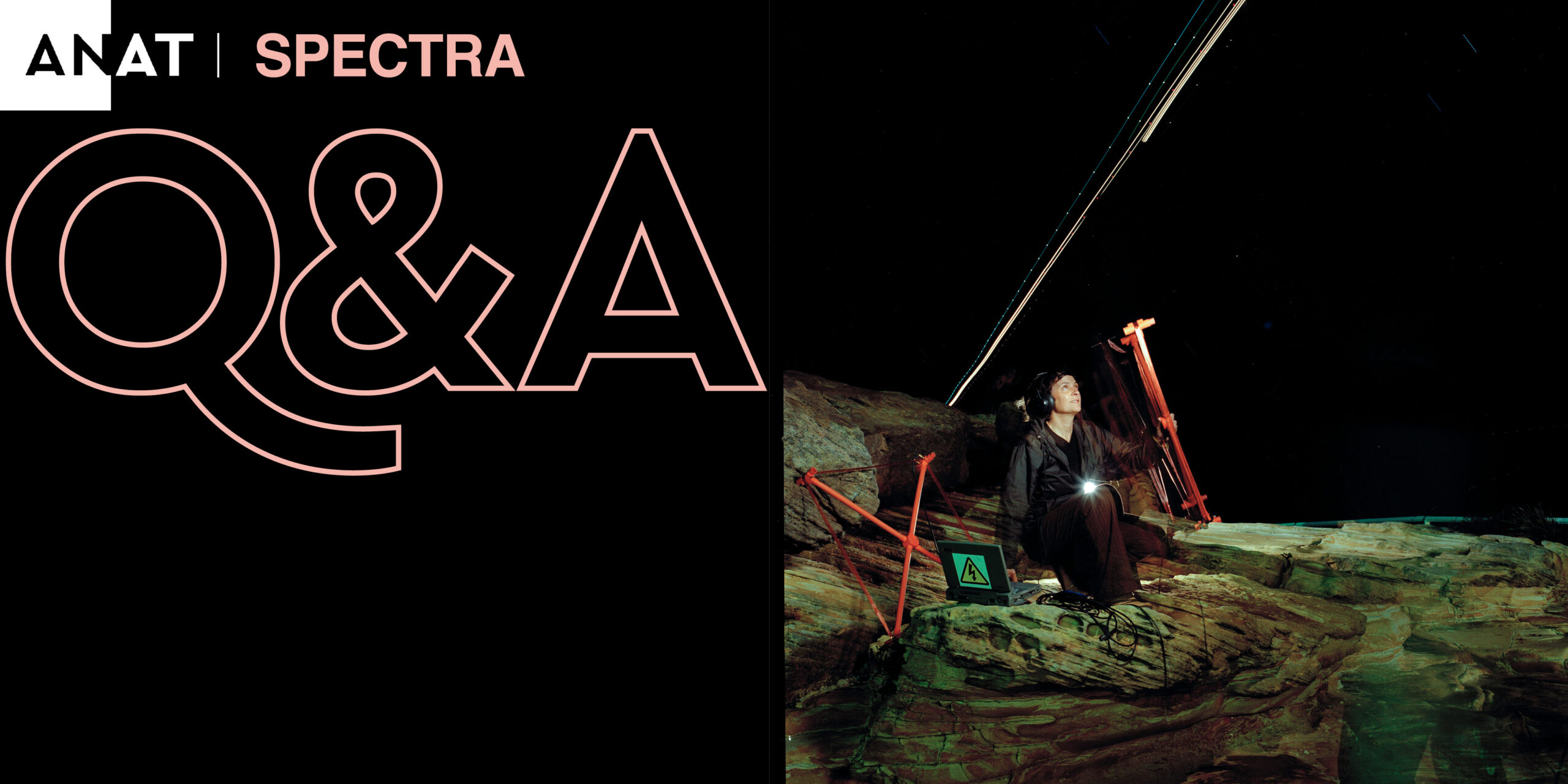
Joyce Hinterding, photograph Stephen Oxenbury Photography
Joyce Hinterding
Joyce Hinterding is an Australian artist based in The Blue Mountains, on the Land of the Dharug and Gundungurra people. Her practice is internationally renowned for exploring the broader concept of Energy through extensive fieldwork and research into electromagnetic phenomena with large sculptural receiving antennae and experimental graphite drawings. She often collaborates with artist David Haines to produce large-scale, environmentally based artworks that incorporate immersive, real-time interactive 3d environments. She has exhibited extensively nationally and internationally, including the 23rd Biennale of Sydney Rīvus 2022 and the 2002 and 1992 Sydney Biennales. In 2015, her collaborative work with David Haines was featured by the MCA in the survey exhibition Energies Haines & Hinterding, and in 2016, they produced an extensive monograph exhibition titled Résonances Magnétiques – La Panacée, Montpellier, France. In 2019, Joyce was awarded the Australia Council Emerging & Experimental Arts Award. Sumer Gallery in Auckland, New Zealand, and Syrup Contemporary in Sydney represent Joyce.
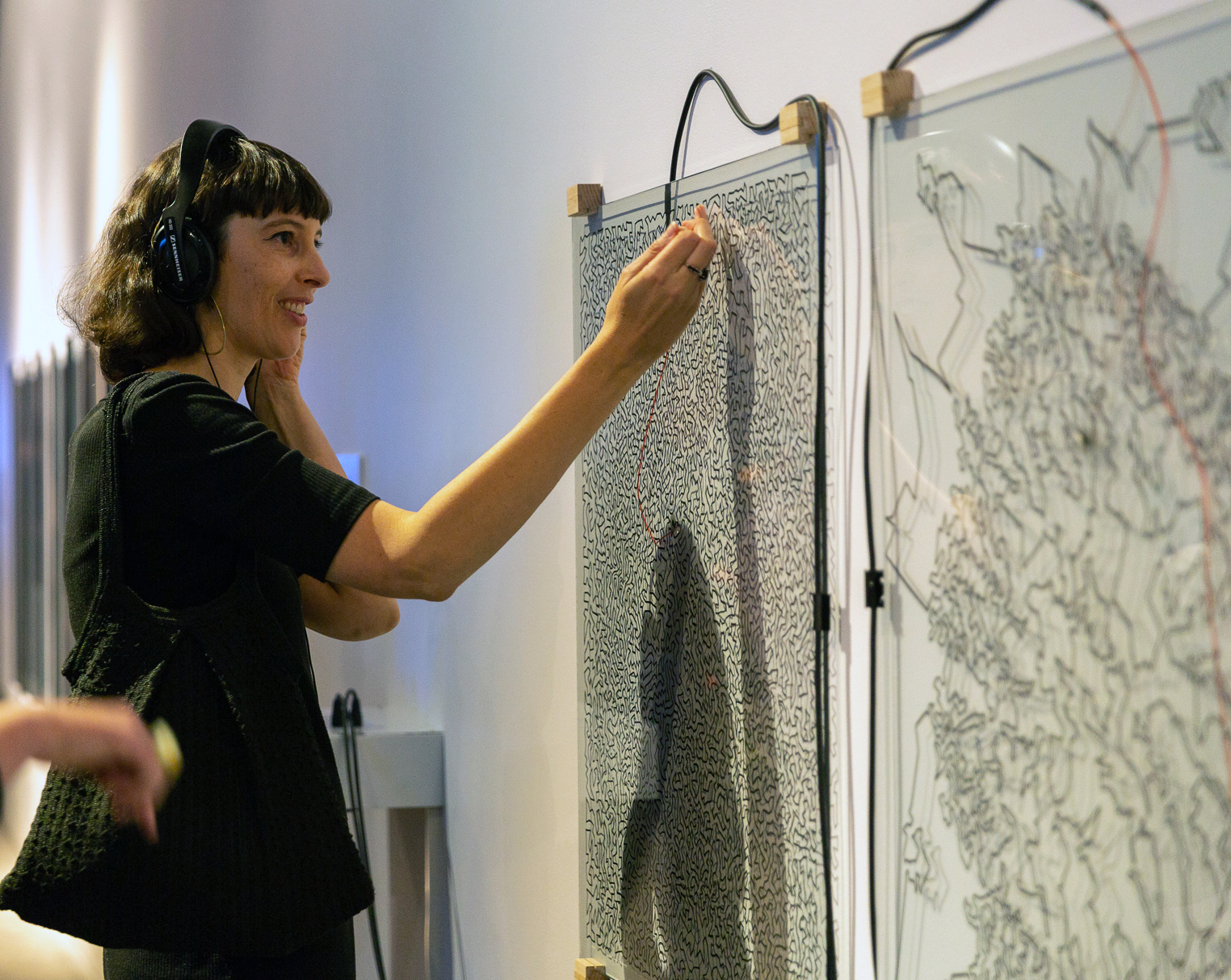
Floric Antenna 1 (Orange Lichen Study) & Floric Antenna 2 (Orange Lichen Study) 2018 Installation view: UTS gallery. Graphite, glass, custom audio cables and fittings mixer with headphones, 2 units each 95 x 95 cm. Photograph Zan Wimberley, courtesy of UTS Gallery.
Tell us about your experience with ANAT SPECTRA.
I exhibited in ANAT SPECTRA 2018 :: The Art and Consequence of Collaboration, at the South Australian School of Art Gallery (SASA) in Adelaide, which then travelled to Sydney for exhibition at the UTS Gallery in 2019. Both exhibitions provided a great opportunity to showcase two experimental works within a context that embraced the exploration of aesthetics and functionality, leading to connections that both verified and expanded my understanding.
Floric Antenna 1 (Orange Lichen Study) & Floric Antenna 2 (Orange Lichen Study) (2018) are two “broadband energy scavenging, graphite loop antennae” that connect drawing, circuit diagrams, and natural growth patterns. They are derived from observations of Lichen, an organism that relies on a symbiotic relationship between fungi and algae. Lichen’s fungal substructure provides the physical support and derives its energy from decomposition, while the algae on the surface harness the electromagnetic energy from the sun to photosynthesise; together, they form a highly successful, optimised resonant energy-receiving structure. The translation from observed form to graphite loop antenna is where the medium of drawing connects to the technological world of circuit diagrams and the graphic language of electronics. The inherent conductivity of graphite allows a drawing of a loop antenna, based on space-filling curves derived from algorithmic analysis, to become energised by the surrounding electromagnetic environment.
UTS purchased Floric Antenna 1 (orange Lichen study) for their collection and, in 2020, designed an online STEAM learning module to accompany this work. This module was developed in collaboration with Melissa Silk from STEAMPOP, Mathematician Mary Coupland, the director of UTS Women in Engineering, and Alexandra Thomson from the UTS Deep Green Biotech Hub.
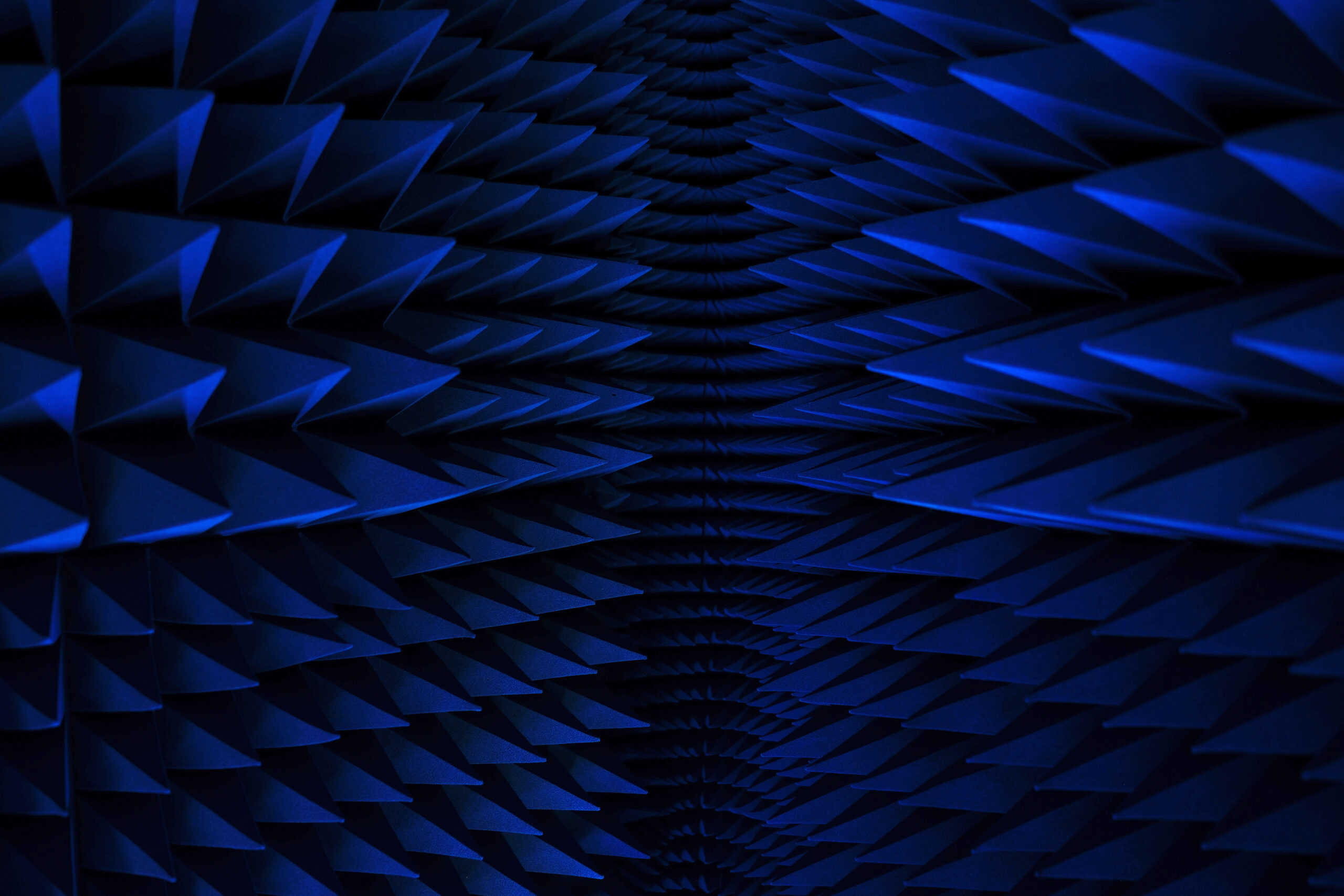
David Haines & Joyce Hinterding, Telepathy, 2008, Interior View 2024, Energy Fields: Vibrations of the Pacific Fulcrum Arts and Chapman University, California, USA. Custom anechoic acoustic tiles, acoustic blanket, plywood, timber frame, plasterboard, Air extraction unit. 6.0m x 4.8m x 4.8m x 2.4m. Photograph Haines Hinterding.
“Throughout my lifetime, I have utilised art as a platform to explore not only ideas but also new technical realms, frequently venturing into uncharted territory by combining the design functionality of an undergraduate training in silversmithing with the expanded conceptual space of Sculpture.”
What or who inspires you in the realm of interdisciplinary practice, and why?
Interdisciplinary practice and thinking are vital for complex problem solving. Throughout my lifetime, I have utilised art as a platform to explore not only ideas but also new technical realms, frequently venturing into uncharted territory by combining the design functionality of an undergraduate training in silversmithing with the expanded conceptual space of Sculpture. I also believe my upbringing and parents played a significant role in this. They migrated from Rotterdam in the Netherlands in the late 1950s, following World War II, driven by a desire to start anew, and as a child, I grew up with an unlimited idea of what was possible. My father and his family were printers, and my grandfather printed the journal Vrij Nederland for the Dutch underground during the German occupation. My mother’s father was an electrician involved in the electrification of Rotterdam, and my grandmother came from Zeeland, the land that exists below sea level. The result was that one half of the family is now connected to the atelier world of printing, drawing, and the arts and the other to technology and engineering. I have always felt curiously caught between those two worlds. Fortunately, my partner and collaborator David Haines, shares a similar disposition. As autodidacts, we have encouraged each other to explore new ideas and figure out how to do things, from building sculptural custom antennae for listening and energy scavenging to working at the forefront of immersive digital media. The material and energetic worlds combine in our work.
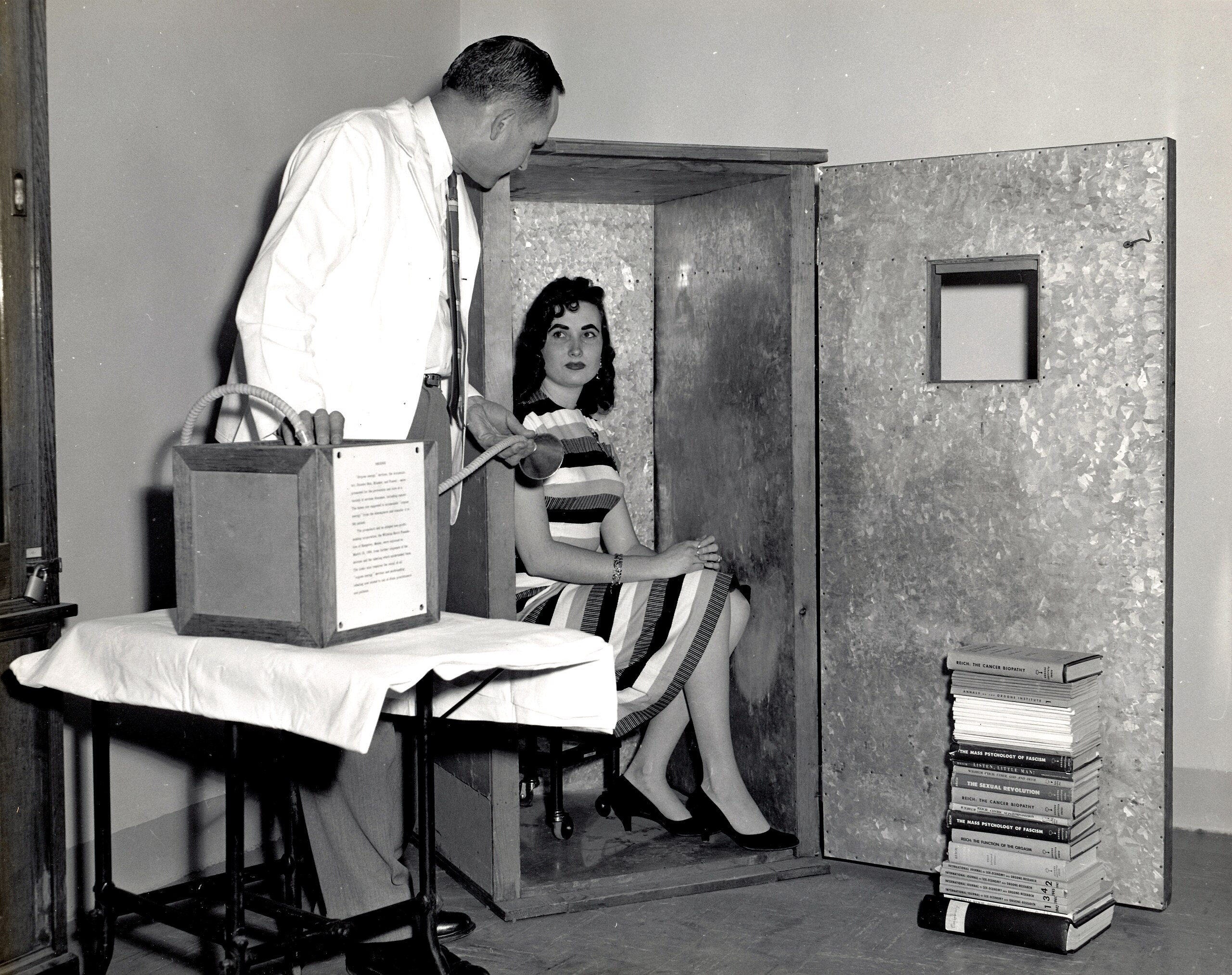
Psychiatrist Wilhelm Reich declared the existence of a universal healing and revitalizing force, called orgone, and created devices (the booth and breathing apparatus are pictured here) to capture and administer it. Image public domain.
Name a cultural work (film, book, music, etc) that inspired or challenged your creative perspective and tell us why.
In 1980, I encountered Wilhelm Reich’s book: The Function of the Orgasm, Volume 1 of the Discovery of Orgone. This was Reich’s first published book for an American audience, where he summarises his clinical and scientific work with the human organism over twenty years. The confirmation of his orgasm theory led to the discovery of a radiating biological energy, which he called Orgone. This research and approach were very inspiring to me and remain so. His devices and material understandings around functionality encouraged me to explore other ways of thinking about energy and introduced a concept that remains with me to this day. The idea that form is a product of movement.
In 1991, while doing a residency at the Australia Council’s Green St Studio, I struggled with the decision of whether to visit Organon, Wilhelm Reich’s Laboratory in Maine USA or Walter De Maria’s Lightning Field. Unfortunately, I didn’t get to go to Organon. Still, I did visit New Mexico and experience Walter de Marias’ lightning field—a work full of desire, a sculptural form that has a most extraordinary functionality. The 400 stainless steel poles are designed to attract lightning strikes during thunderstorms. The poles ground lightning when atmospheric conditions cause a discharge, making it more likely for lightning to strike the poles rather than the surrounding areas. The work requires considerable effort to visit, and the insights gained from being there in person cannot be underestimated. In the weeks leading up to this and on arrival, I found myself wishing for the massive, energetic exchange between earth and sky that a lightning storm can produce, only to discover that the Trinity Test Site is 100 miles away. The work evokes a fundamental desire within us, inspiring me to explore energy and form further, and to develop my interest and artwork around high-energy systems. The artwork I produced after this, titled Electrical Storms 1991, was an assemblage comprised of two high-voltage custom-built electrostatic sound systems and a large VLF (Very Low Frequency) loop antenna that monitored in real time the radio bursts bouncing around the Earth’s ionosphere, known as Whistlers and Sferics. Accompanying this was a VLF recording of the atmosphere at the lightning field from that evening in 1991.
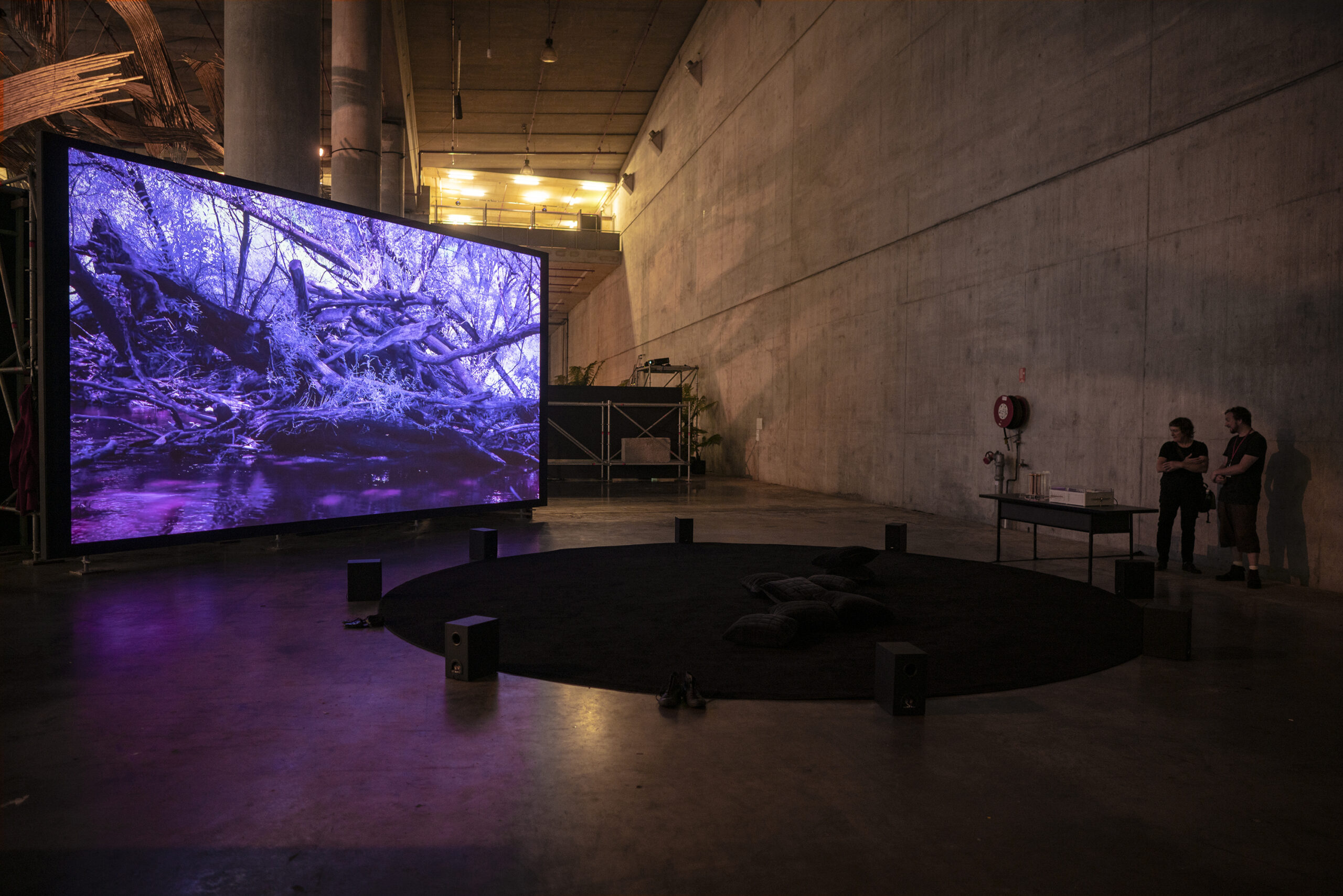
David Haines & Joyce Hinterding, Pink Steam, 2022, Installation View: 23rd Biennale of Sydney 2022, Video and sound installation: Single Channel Video shot in hyper colour infrared at 470 nm on a specially modified camera, Stereo Sound + 6 Channel live sound of Cosmic Rays (muons) – Cosmic Ray Detector: Geiger Muller Array, Muon Counter, various electronics, table, amplifiers. Dimensions variable: DUR 56:31. Photograph Haines Hinterding.
If you could collaborate with any figure from history or contemporary culture, who would it be and why?
After having done so much listening and thinking around the robustness of the loop antenna and the Very Low Frequency (VLF) part of the spectrum and more recently, working through possibilities and ideas around fractal and logarithmic antenna, I would like to collaborate with The Square Kilometre Array (SKA), an intergovernmental international radio telescope project being built in Australia (low frequency). Particularly, Dr. Maria Grazia Labate, the Italian SKA-Low Telescope Engineer, who designed the logarithmic tree-like radio antenna for the array in Western Australia on the lands of the Wajarri Yamaji at Inyarrimanha Ilgari Bundara, the CSIRO Murchison Radio-astronomy Observatory. David Haines and I have been exploring the ironstone/ sandstone geological structures, known as Pagodas, in the Gardens of Stone, part of the Blue Mountains World Heritage. I would love to share our observations and thoughts and gain a deeper understanding of the functionality and processing required to decode the information received by large-scale radio telescopes. Our recent collaborative work for the Sydney Biennale 2022, Pink Steam 2022, featured custom-built muon detectors and a collaboration with Stem Educator Robert Hart. This was an eye-opening and brain-expanding experience that continues to deliver valuable insights. Our collaborative work, Lichen and stars 2024, is another work where the observation, so essential to art and Science, finds a central place.
What’s next? Tell us about your next project, collaboration or thinking
I am continuing to work on the graphic antenna based on lichen and coupling them with graphic capacitors to form oscillating resonant circuits. My latest exploration is comprised of a 16-kt green gold-leaf antenna and a silver-leaf capacitor. The antenna gathers low-frequency energy from the surrounding environment, and the capacitor provides a short-term storage that sets up an oscillation. The components have tiny electrical values and, as a result, oscillate in the inaudible MHz range, but the low-frequency component of scavenging activity is audible via headphones. I am keen to keep working on these oscillators, as I have lots of ideas around the forms and materials, based on thoughts about emergent structures and my observations of self-assembly in the natural environment.
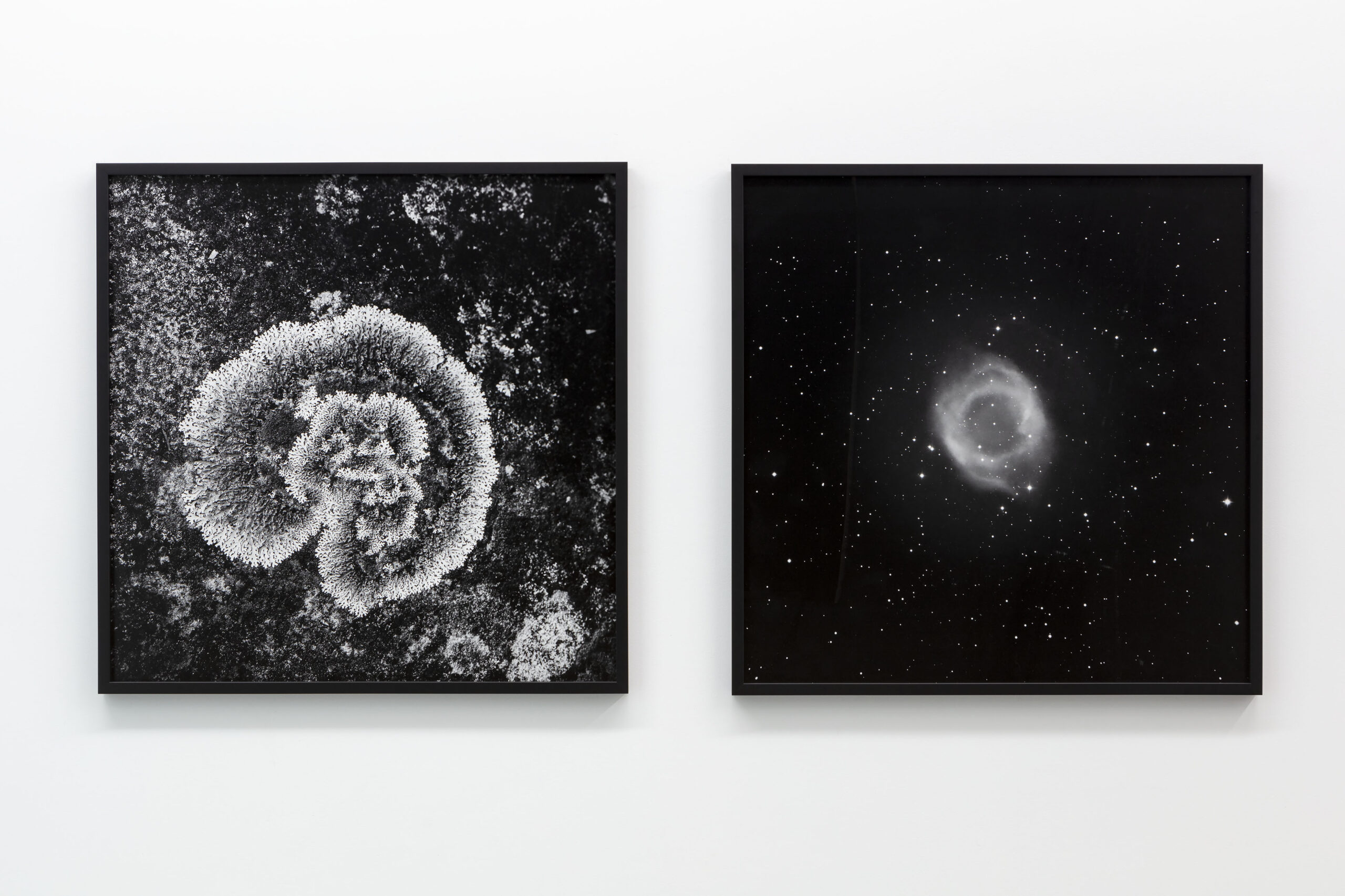
David Haines and Joyce Hinterding, Lichen and Stars 3 (Kings Tableland / NGC7293 Helix Nebula), 2021, pigment print on Ilford Gold Fibre Pearl 290gsm, 2 units, each 93 x 93cm (framed). Photograph Ashley Barber.
David Haines and I are collaborating with the Wired Lab and Castlepeak Architects on a permanent, standalone version of our immersive artwork, Telepathy, a monolithic, artist-created anechoic chamber designed to insulate occupants from external sound and noise, while also absorbing energy and vibration. The new version of this work will be built on the grounds of the deconsecrated Church of the Immaculate Conception in Muttama, NSW.
Alongside this, David and I are working on a new Unreal Game engine artwork for exhibition at the Blue Mountains Cultural Centre in 2027. This latest work will continue to develop our vision of a speculative environmental techne. This virtual world is imagined and derived from Blue Mountains data gathering, field trips, real-world scanning and recording in the local environment. Combining planetary-scale visualisations with the local into a multilevel interactive environment. In this experience, the laws of physics and forces that assemble and disassemble things will become part of the audience’s awareness, sparking a provocation about people’s position within the post-colonial Anthropocene.
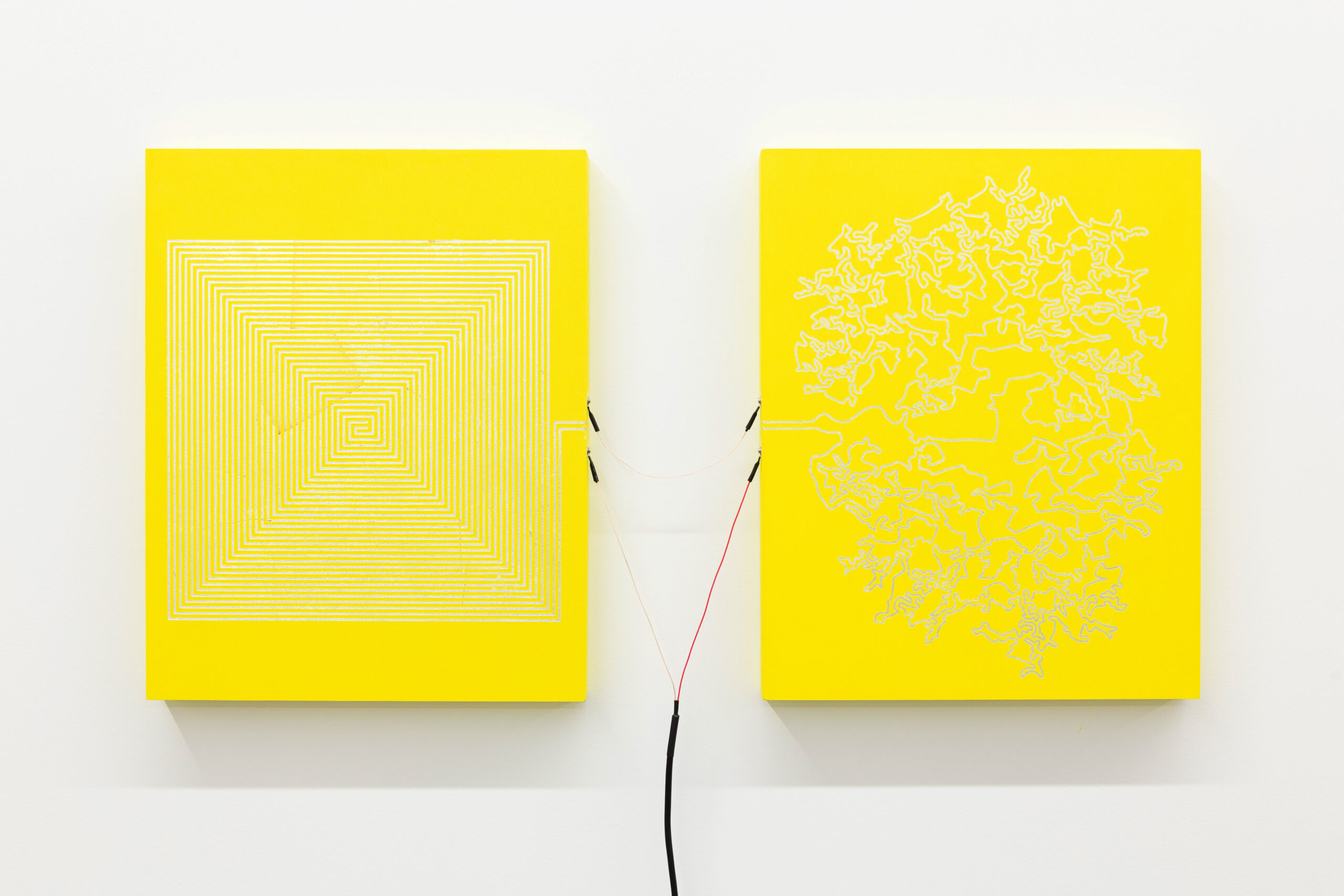
Joyce Hinterding, LC Lichen Oscillator (Cadmium Yellow) 2025, Installation View: Sumer NZ, 16k green gold leaf lichen antenna, sterling silver leaf capacitor, acrylic on board, metal fittings, mixer with headphones, 2 units each 40.6 x 50.8cm. Photograph Dan Du Bern.